Keith Alexander · 1946 – 1998
Biography
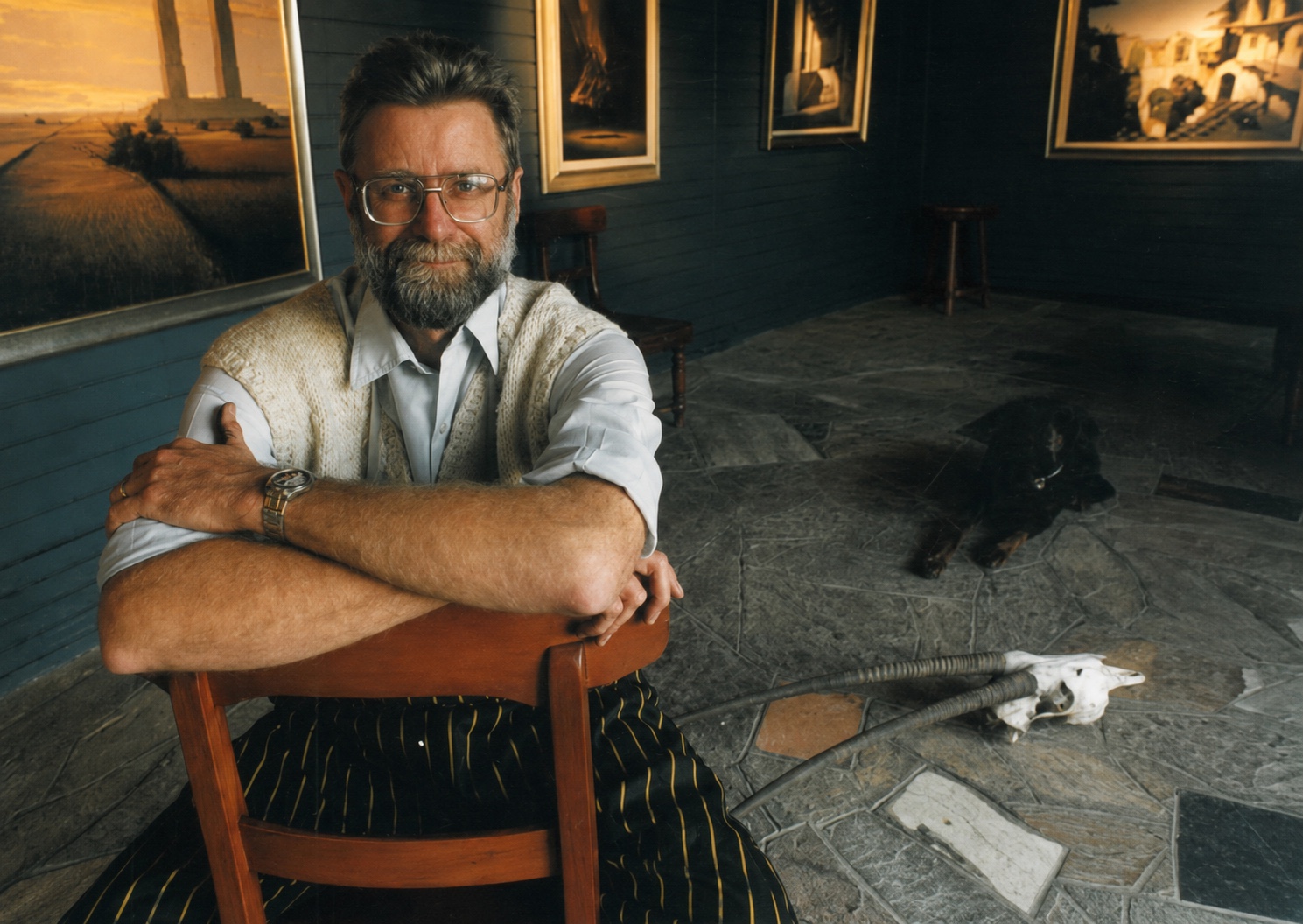
Keith Alexander, one of South Africa's greatest realist artists, created an impressive oeuvre of over 500 immediately recognisable photorealist and surrealist paintings over a relatively short career of 25 years.
Specific memories from his life experiences were used as motifs in his work throughout his career, beginning with memories of the 10 000-acre farm his family owned in his country of birth, Rhodesia (now Zimbabwe). He attended boarding school in London where the damage sustained during war-time bombing raids still lingered, and upon returning to southern Africa, he became increasingly aware of the contradictions inherent in his deeply colonial and politically fraught upbringing.
His decision to study art at the University of Natal was based on the affordability of the books for the course, and he majored in sculpture in his undergraduate Fine Arts degree. In his Honours thesis, he explored Surrealism and studied the work of Salvador Dalí, Joan Miró, Max Ernst and René Magritte. After university, he attempted to make a living as a sculptor with minimal success. In 1974, he started painting instead.
My perception of what art should be had begun to change. In fact, I came to the realisation that I wasn't a sculptor at all. Gradually, my thoughts turned towards putting paint on canvas, and also to the Surrealism I had researched for my honours thesis.
A key aspect to understanding the life and work of Keith Alexander is the love story between him and his wife Elizabeth White. They met in 1972 when Elizabeth purchased a sculpture from him at an exhibition and commissioned a second one. She immediately recognised his potential and became both his muse and his business manager.
Keith lived in White River when they met, but after getting married, the couple moved to Johannesburg. On their honeymoon they travelled to the quiet towns in southern Namibia, which was a turning point for the artist as he fell in love with the desert. On annual visits, Keith and Elizabeth continued to explore the Namib desert and it became the central focus of his work.
A series of paintings on the story of the Eduard Bohlen, a German-built vessel that had been wrecked off the Skeleton Coast in 1909, brought him immediate fame both locally and internationally. Keith and Elizabeth continued to travel throughout Africa, and although a visit to Madagascar was influential, it was the desert that enabled him to create a language of his own, through which he could articulate his personal vision.
There's a sadness in my paintings, I use Namibia as a medium for the colonial collapse, the transition, as in South Africa today, from the old order to the new. The physical language is so aggressive and hostile. At the end of it all, though, Africa will be there forever. Long after all the schemes and dreams have passed, it remains the ultimate winner.
Elizabeth successfully handled the business side of Keith's career, including public relations, marketing and promotion, while also managing their household affairs so that he could be free to concentrate on his painting.
Sadly, Elizabeth was diagnosed with colon cancer, and during her treatment, Keith himself fell ill with a brain tumour. The couple supported each other, side by side, until Keith's untimely demise on 17 November 1998. Elizabeth passed away six months later.